
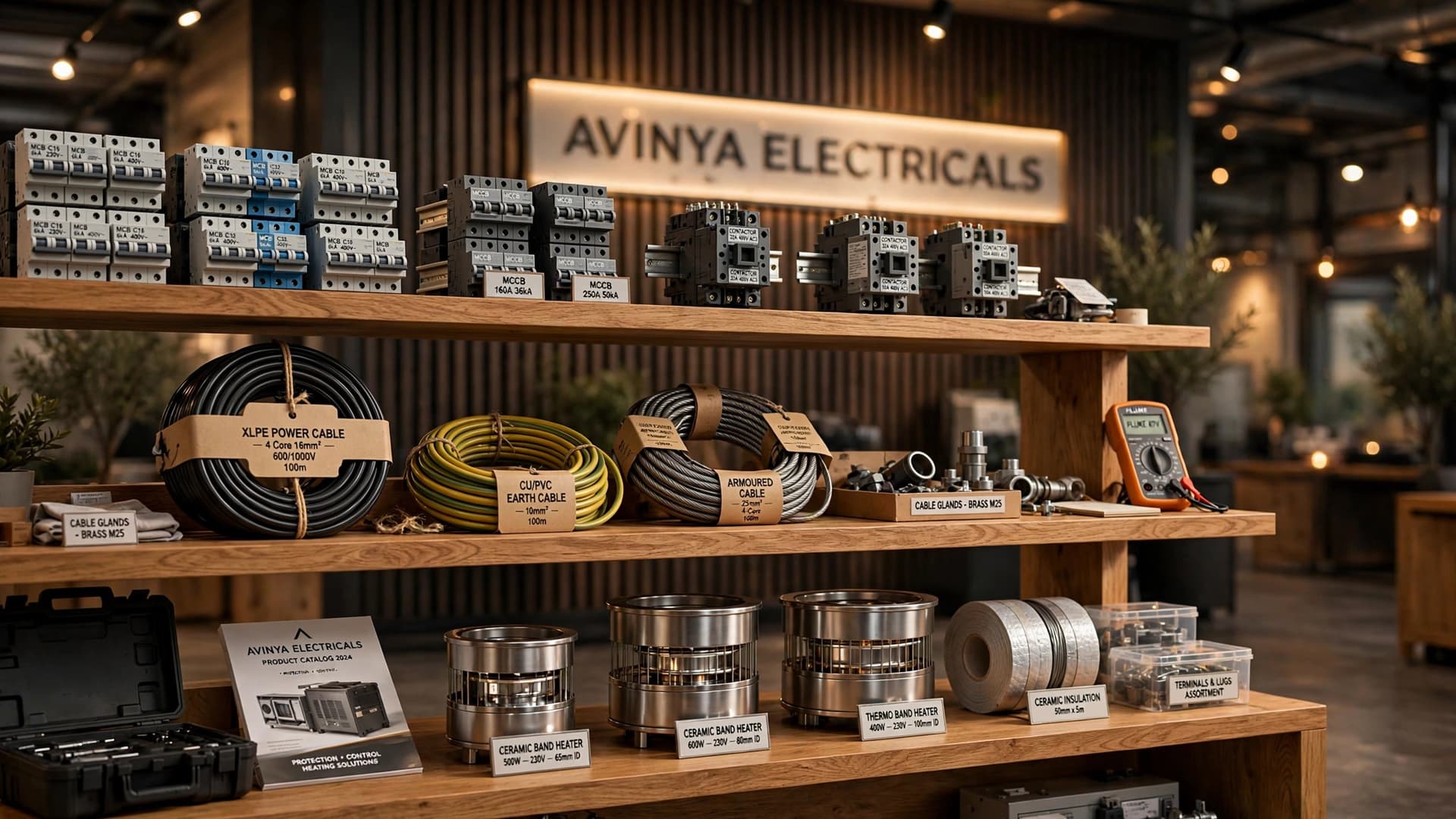
Industrial Electrical Equipment: The Complete 2026 Guide for Plant Buyers
Every factory floor in the country runs on one invisible backbone: industrial electrical equipment. From the breaker that protects a single motor to the heating elements running a 24x7 extrusion line, the equipment you choose decides your plant's safety, uptime and maintenance budget.
Yet in most plants, electrical equipment is still bought reactively — a breakdown happens, someone calls the nearest shop, and whatever is on the shelf goes in. That habit costs Indian industry crores every year in avoidable downtime, rework and electrical failures.
This guide is for plant heads, maintenance engineers, panel builders and contractors who want to buy smarter. It covers what industrial electrical equipment includes, where each category is used, how to select the right specification, and how to source genuine stock at fair prices.
What Is Industrial Electrical Equipment?
Industrial electrical equipment is the family of components and systems engineered to distribute, control, protect and convert electricity in industrial and commercial environments. Unlike domestic electricals, industrial equipment is designed for higher voltages (415V 3-phase as standard in Indian industry), heavier currents, continuous duty cycles, high ambient temperatures, dust and vibration — and must comply with standards such as IS, IEC and CE.
A medium-size manufacturing plant typically holds hundreds of equipment types across its power distribution network, machine fleet, control panels, automation systems and heating lines. A single wrong specification — or one duplicate component — can halt a production line or cause an electrical fire.
Main Categories of Industrial Electrical Equipment
Category | Typical Equipment | Core Application |
|---|---|---|
Switchgear & Protection | MCBs, MCCBs, RCCBs, isolators, SFUs | Circuit protection, power distribution |
Cables & Wiring | LT power cables, control cables, FR/FRLS wires | Plant wiring, machinery connections |
Control & Automation | Contactors, overload relays, VFDs, PLCs | Motor control, process automation |
Heating Equipment | Ceramic band, mica band, cartridge, coil heaters | Plastics, packaging, food processing |
Panels & Enclosures | MCC/PCC panels, distribution boards, IP-rated enclosures | Centralised control and distribution |
Components & Accessories | Terminal blocks, busbars, cable glands, lugs, conduits | Panel building, cable management |
Industrial Lighting | LED highbays, floodlights, flameproof lights | Factory floors, warehouses |
Earthing & Safety | Earth rods, lightning arresters, surge protectors | Plant safety, statutory compliance |
1. Switchgear and Protection Equipment
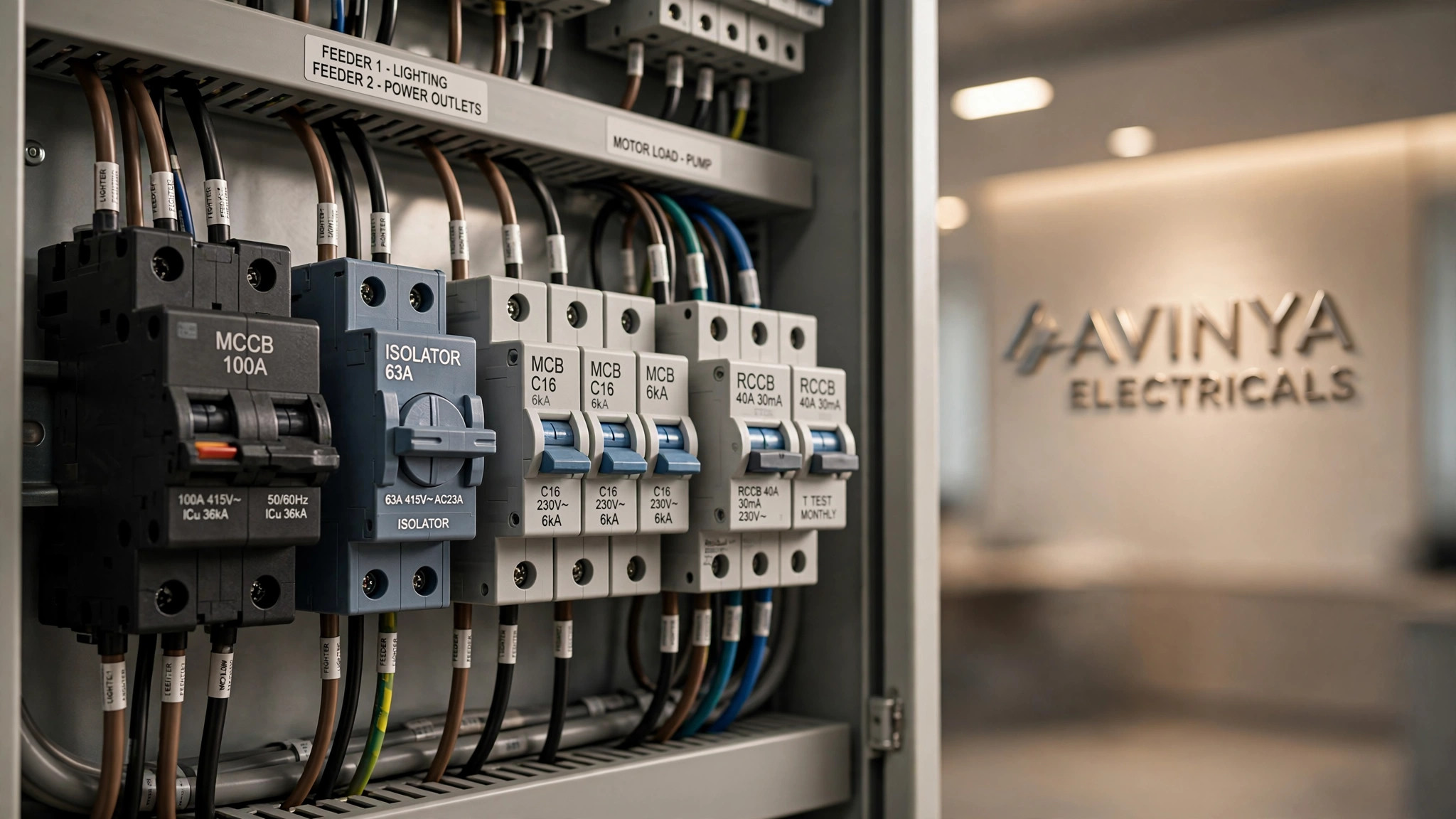
Switchgear is the immune system of your plant. MCBs protect branch circuits from overload and short circuit; MCCBs handle main distribution up to 1600A; RCCBs protect personnel from earth leakage; isolators and switch-fuse units give safe isolation for maintenance. The single most critical selection rule: the breaking capacity (kA rating) must exceed your installation's prospective fault current. A 6kA MCB on a 10kA-fault circuit will not save your panel — it will endanger it.
2. Cables and Wiring Systems
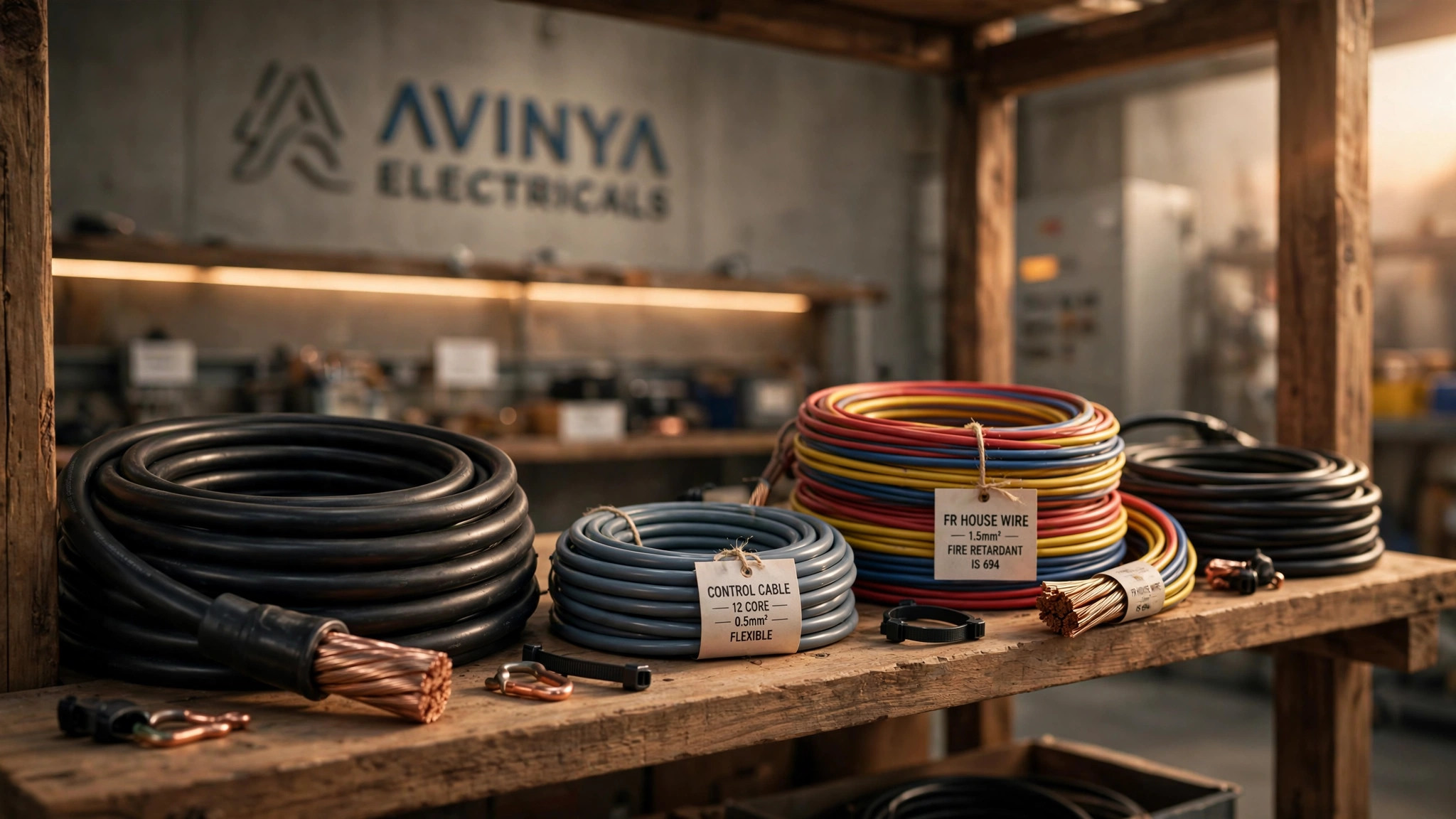
Cables are your plant's arteries. LT XLPE power cables feed machinery; flexible multicore control cables connect panels to motors and sensors; FR and FRLS house wires (as per IS 694) handle building wiring. Selection hinges on conductor material (electrolytic copper for reliability), insulation type (PVC vs XLPE vs heat-resistant), voltage grade (1.1kV for LT systems), and current-carrying capacity with proper derating for ambient temperature. Undersized cables run hot, waste energy and age prematurely.
3. Control and Automation Equipment
Contactors switch motors on and off thousands of times a day; overload relays protect those motors from burn-out; push buttons, selector switches and indicating lamps form the operator interface of every panel. For automated lines, VFDs control motor speed and save energy, while PLCs run entire processes. This category is the most counterfeited in the Indian market — a duplicate contactor with fake ratings is a leading cause of motor failures. Buy automation gear only from authorised sources.
4. Industrial Heating Equipment
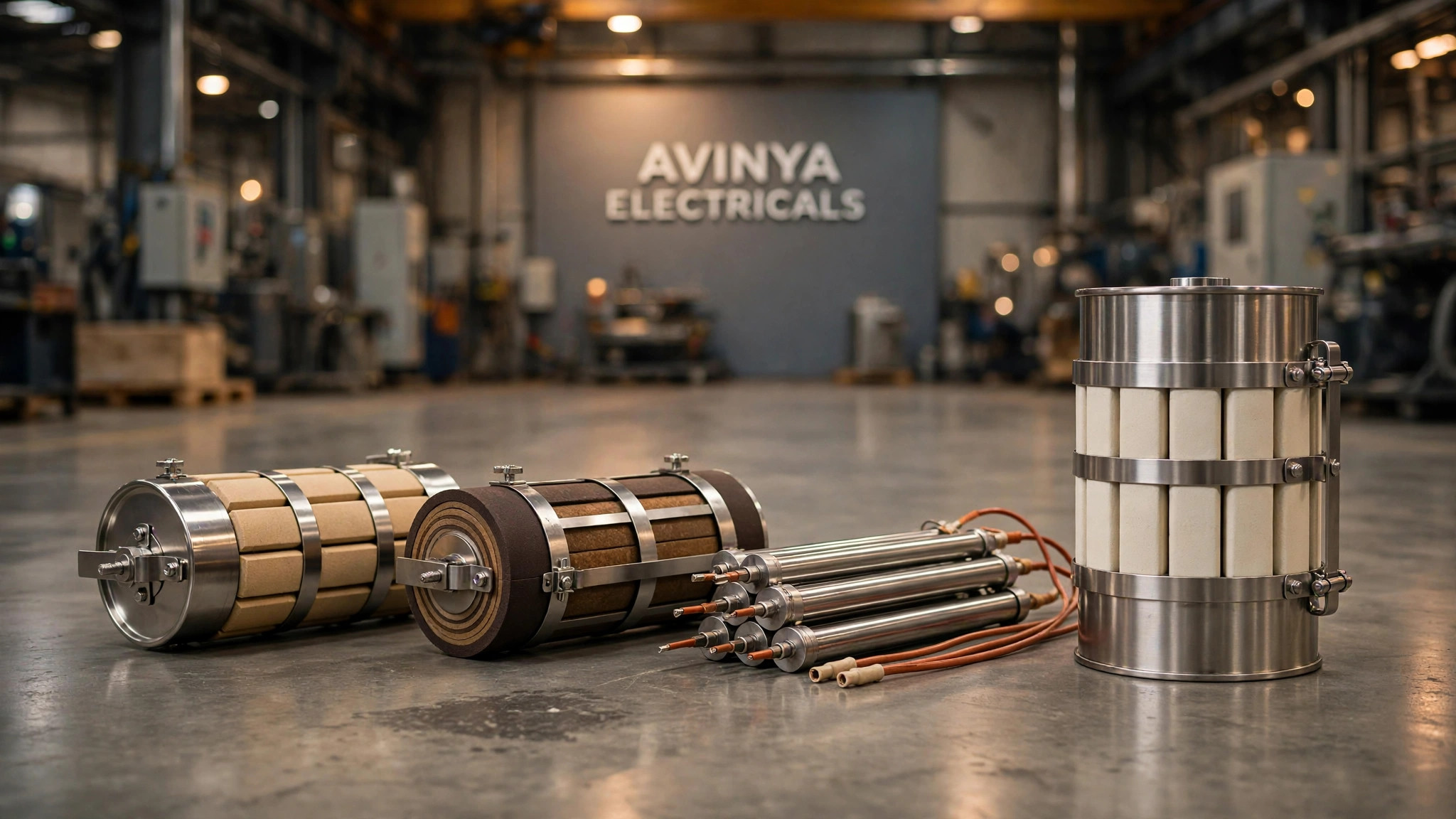
For plastics extrusion and injection moulding, blow moulding, packaging, food processing and textile stenters, heaters are critical consumables. Ceramic band heaters suit high-temperature barrels with good energy efficiency; mica band heaters fit lower-temperature, compact applications; cartridge heaters deliver concentrated heat inside moulds and dies; coil/nozzle heaters wrap hot-runner nozzles. Match watt density and operating temperature to your process — an underspecified heater dies early, an overspecified one wastes energy and damages the barrel.
5. Panels, Enclosures and Components
Distribution boards, MCC/PCC panels, terminal blocks, copper busbars, cable glands, lugs, ferrules, DIN rails and enclosures turn loose components into a safe, serviceable system. IP rating is the key selection factor: IP54 for dusty shop floors, IP65/IP66 for washdown or outdoor areas. In chemical plant zones, flameproof (Ex-d) enclosures and fittings are often mandatory.
6. Which Industries Use This Equipment?
Chemical & pharmaceutical plants — flameproof fittings, corrosion-resistant panels, instrumentation cables
Plastics & packaging — band heaters, temperature controllers, MCCBs for extruders and moulding machines
Textile processing — motors, drives and heaters for stenters, dryers and dyeing units
Engineering & fabrication — welding equipment, power distribution, EOT crane panels
OEM machine builders — bulk switchgear, contactors and control gear for new machines
EPC & infrastructure contractors — cables, cable trays and lighting for greenfield projects
Maintenance & MRO teams — replacement breakers, contactors, heaters and lamps for breakdown spares
7. Point Buying Checklist
Start from the application, not the catalogue — a contactor for a DOL motor starter vs an APFC capacitor bank needs different duty categories (AC-3 vs AC-6b).
Size ratings with headroom — keep at least 25% headroom for continuous loads.
Verify breaking and short-circuit capacity — the kA rating must exceed your fault level.
Match the environment — specify IP ratings and temperature ratings in your PO; a 40°C-rated component derates badly in a 55°C summer shed.
Insist on genuine brands and certifications — ISI marks, CE, IEC compliance, GST invoices from authorised dealers.
Think total cost, not purchase price — a cheap duplicate contactor costs far more in downtime than a genuine one.
Confirm availability and lead time — for breakdown spares, same-day local availability beats a 5% lower price from a distant supplier.
Genuine vs Duplicate: The Cost of Cutting Corners
The Indian electrical market has a serious counterfeit problem — duplicate MCBs, undersized-copper wires and fake branded heaters. The risks: safety (fake protection devices may not trip during a fault), downtime (duplicates fail far earlier), void warranty (manufacturers reject claims when duplicates caused the failure), and legal exposure (non-ISI electricals can violate factory safety norms). Buy from an authorised dealer, take a GST invoice, check holograms/QR codes, and treat below-market prices as a warning sign.
Why Source From an Authorised Dealer?
Genuine stock from 40+ MNC brands — Polycab, Havells, Legrand, ABB, Siemens, Crompton, L&T and more
Wholesale + retail pricing with transparent quotes within 1 hour
Ready stock for breakdowns, same-day dispatch
Technical help selecting the right specification
Proper GST invoicing and warranty support
Avinya Electricals has served 300+ manufacturing and infra clients for over 5 years on exactly these principles.
Frequently Asked Questions
Q1. What comes under industrial electrical equipment?
Switchgear and protection devices (MCBs, MCCBs, RCCBs), cables and wires, control and automation components (contactors, VFDs, PLCs), industrial heaters, panels and enclosures, lighting, and earthing equipment.
Q2. How do I choose the right industrial electrical equipment supplier?
Look for an authorised dealer with multi-brand genuine stock, GST invoicing, technical selection support and same-day dispatch. Avinya Electricals is an authorised dealer for Polycab, Havells, Legrand, ABB, Siemens, Crompton, L&T and 40+ MNC brands, serving 300+ industrial clients.
Q3. What is the difference between MCB and MCCB?
MCBs protect individual branch circuits (up to 125A); MCCBs handle higher currents (up to 1600A) for main distribution with adjustable trip settings. Both must be sized to your fault level's kA rating.
Q4. How can I verify that industrial electrical equipment is genuine?
Buy from an authorised dealer, take a GST invoice, check ISI marks and brand holograms/QR codes, and compare prices against the brand's official price list — unusually cheap usually means duplicate.
Q5. Do you offer wholesale pricing for bulk and project orders?
Yes. Avinya Electricals offers wholesale rates for plants, contractors and panel builders on bulk quantities, and retail pricing for maintenance spares — with quotes within 1 hour of enquiry.
Conclusion
The right industrial electrical equipment — correctly specified and genuinely sourced — means fewer breakdowns, safer plants and lower lifetime cost. Use the checklist above for every purchase, insist on genuine brands with proper documentation, and partner with a local authorised dealer who understands your application.
Get a free quote today. Call or WhatsApp +91 8000529452, or email [email protected] — quotes within 1 hour, genuine stock, best prices, fast dispatch.